
Haque, Aijaz Ahmad
| Birth Name | Haque, Aijaz Ahmad |
| Gender | male |
| Age at Death | 81 years, 2 months, 8 days |
Notes
Note: 1
Aijaz was born in Muzzafarnagar District,
United Provinces (now Uttar Pradesh), India, 1941 and died in Irvine, Orange, California,
09 Mar 2022.
Note: 2
Written by Gabriele Schwab, Distinguished Professor of Comparative Literature and Anthropology, on Behalf of the Department of Comparative Literature
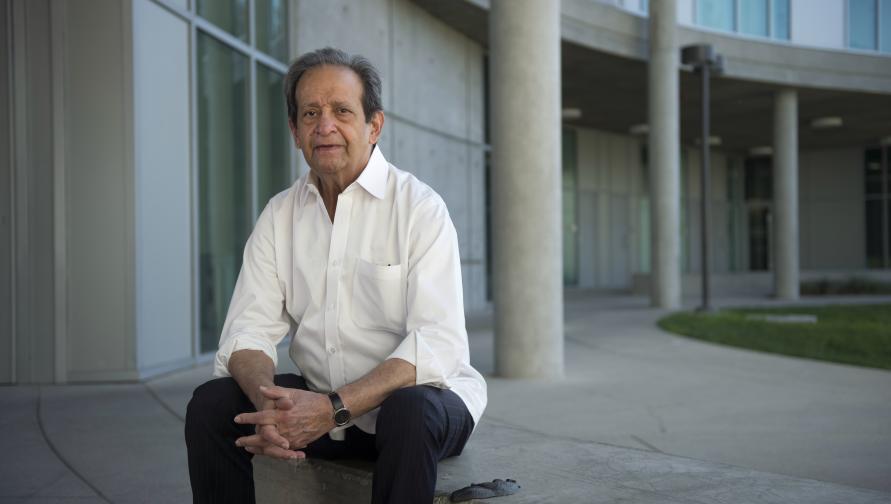
It is with profound sadness that we announce the passing of our esteemed colleague and friend Aijaz Ahmad, internationally prominent literary and critical theorist, and one of the world’s foremost Marxist thinkers of our time. He died at his home in Irvine on March 9th, 2022, where he was able to take leave of his children and a few close friends including Ph.D. students.
Aijaz joined the Department of Comparative Literature at UCI in 2016 for a position in Global Critical Theory and Comparative Literature, after having previously held various appointments as a Distinguished Visiting Professor in Critical Theory, first in Spring 2011. Aijaz Ahmad was one of the leading critical theorists and literary scholars worldwide. Having been at the forefront of Marxist theory with a focus on literature and culture, internationalism, imperialism, and post/colonialism for over three decades, Ahmad authored seven pathbreaking and highly influential monographs as well as hundreds of academic essays and journalistic pieces. Forcefully engaging a subliminal Eurocentric bias in the work of Edward Said’s concept of orientalism and Fredric Jameson’s interpretation of Third World literature, Ahmad’s In Theory: Classes, Nations, Literatures (London: Verso, 1992), for example, completely reshaped the intellectual conversation in critical theory and postcolonial studies. In subsequent years, he engaged leading voices in critical theory, including Jacques Derrida, Slavoj Zizek, Alain Badiou and Gayatri Spivak, revisiting debates about theory and politics from the perspective of the neoliberal turn that emerged after the collapse of the Soviet Union and the end of the cold war. In Ahmad’s more recent work, his critical interventions again set a new paradigm in critical theory by exploring the new role of political theory in the post-communist era in the 1990s. Lineages of the Present: Ideology and Politics in Contemporary South Asia (2000) established him not only as one of the most prominent critical theorists of South Asia, but also as one of the most powerful voices in theoretical debates about global nuclear politics. Finally, with On Communalism and Globalization, which analyzes neo-imperialism and the increasing influence of fascism in third world societies, Ahmad became one of the most challenging voices in debates about what we could call, using his term, the global neo-imperial turn. In a similar vein, many of Ahmad’s essays stimulated new thought in various fields, were translated into many languages, and reprinted in new editions and contexts. “Postcolonial theory and the ‘Post’ Conditions” – a topic on which Professor Ahmad held highly successful graduate seminars at UCI – critically analyzes the main philosophical, political, and epistemological trends in today’s diverse global cultures. “Islam, Islamisms and the West” opened a new horizon on the intertwinement of the crisis in global capitalism and the crisis in today’s Islamic world.
In addition to Aijaz Ahmad’s distinguished career in literary studies, critical and literary theory, and global Marxism, he also established himself as a distinguished poet and novelist in his native Urdu with several books of poetry and a novel. His essays on the history of Urdu as a literary language as well as on the multi-lingual and multi-vocal character of Indian literature are a testimony of his commitment to lend a voice to literary works beyond the monolingual hegemony of English. His capacity to span different cultures and historical epochs is unparalleled in critical theory and literary studies. The same is true for his capacity to make his work speak across the boundaries of departments and schools. He not only established his unique distinction in the fields of critical theory, discourse analysis and literary studies; he also earned distinction as a philosopher, a social scientist, and a political theorist and activist. Finally, he also had a distinguished career as a translator. Translations of Urdu Poems, including a substantial introduction, have appeared in The Hudson Review and in Poetry, and he has also collaborated on translations with distinguished poets, including Adrienne Rich, Mark Strand, W. S. Mervin, and William Stafford.
Aijaz Ahmad held academic positions internationally before accepting his tenured position at UCI in 2016. Previously, he taught at York University (Toronto), Jawaharlal Nehru University (India), Jamia Millia University (India), the School of African and Oriental Studies (London), and the University of Sao Paulo (Brazil). He delivered distinguished lecture series at Oxford, Cambridge, and universities in South Asia and Europe as well as the Distinguished Wellek Lectures in Critical Theory at UC Irvine. Perhaps most importantly, Aijaz Ahmad was also a prominent and highly visible public intellectual who had regular TV appearances in India, was a leading voice on the web-based news portal Newsclick and wrote frequently for leading journals such as Frontline (India) and Monthly Review (US). His role as a public intellectual and scholar activist on the Left was always as important for him as his academic career. Given that he has moved between continents and taught in India, the US, Brazil and Europe, his career did not follow the linear trajectory of conventional academic appointments. After holding a tenured appointment in the US at Rutgers University from 1975 to 1992, he resigned to accept a Senior Fellowship from the Indian Council for Social Research, which allowed him to resume his career as one of India’s foremost public intellectuals. He became senior editorial consultant of Frontline and held a series of highly prestigious Distinguished Visiting Professorships such as the Rajiv Gandhi Chair at Jawaharlal Nehru University, the Khan Abdul Ghaffar Khan Chair at Jamia Millia, and the Asian College of Journalism before accepting his tenured appointment at UCI.
An outstanding and charismatic teacher, Aijaz Ahmad inspired students with his intellectual rigor and passion, pushing them to excel in their work. His foremost concern was to teach how to think and read critically, a skill he deemed indispensable to understand the global entanglements of today’s world in a holistic fashion. His role as a teacher extended far beyond the classroom, including the large and diverse audiences he reached as a public intellectual and writer. At UCI he brought an invaluable wealth of learning and insight to studies of comparative literature and critical theory. Having worked with questions of imperialism, nationalism, world literature, translation studies and literary production and interpretation, he recently turned his attention to pressing topics of religion and culture in the fraught international climate of the 21st century. In 2020, LeftWord published a seminal book, edited by Vijay Prashad, with interviews conducted by Sudhanva Deshpande, Mala Hashmi and Vijay Prashad about Aijaz Ahmad’s life and work. It was to be followed by the publication of Ahmad’s final project, consisting of introductions to Marx’s political writings, which was sadly cut off by his death.
Aijaz will be remembered by generations of scholars from all over the world. As Vijay Prashad wrote, “Aijaz gave us confidence when the eclipse of hope seemed almost complete.” His writings and teachings will leave a permanent trace. Perennial migrant who could never truly call a place his home, he placed his roots in the rhizomatic network of left thought and politics. Deprived of citizenship in India where he was born, he became a citizen of the world of poetry and politics. When we hired him at UCI with the help of Dean Georges Van den Abbeele, during the time I was chair in Comparative Literature, I always thought of Aijaz as a double refugee. He was a political refugee because, according to Indian law, someone who was born in India but then became a Pakistani citizen could not regain Indian citizenship. But he was also a climate refugee because the air pollution in Delhi had permanently damaged his lungs and he needed to move to a different climate. Irvine became a strange sanctuary that ended the cycle of migrations and exiles that marked his life and scholarship. He always told me that being able to move to California gave him the gift of a few more years of lifetime.
Let me end with a few words about Aijaz as the person I knew. Apart from his unfailing commitment as a Marxist scholar and left activist, his deep passion was for the world of literature, poetry, art, and music. He was a literary writer and poet in his native Urdu, but he was also a photographer with the unfailing gaze of an artist who carefully edited his photographs until they became transformed into works of art. Finally, those close to him experienced his rare gift of friendship. In times of joy as well as times of need, he was unfailingly there. He was a great host, chef cook, and connoisseur of good wines. His sense of humor and his joy of life were contagious. Most of all, he deeply engaged the work of colleagues and students with a rare mixture of generosity and rigor, enriching our intellectual life together in innumerable ways. As we mourn him, his absence will fill our world.
Note: 3
Aijaz Ahmad (Hindi: ऐजाज़ अहमद, Urdu: اعجاز احمد; 1941 – 9 March 2022) was an Indian-born Marxist philosopher, literary theorist, and political commentator. He was the Chancellor's Professor at the University of California, Irvine School of Humanities’ Department of Comparative Literature.[1]
Aijaz Ahmad was born in Muzaffarnagar, British Raj in 1941.[2]
He was a professorial fellow at the Centre of Contemporary Studies, Nehru Memorial Museum and Library, New Delhi, India, visiting professor at the Centre for Political Studies, Jawaharlal Nehru University, New Delhi, and visiting professor of political science at York University, Toronto, Canada. He also worked as an editorial consultant with the Frontline and as a senior news analyst for the news website NewsClick.[3][4]
He was a professorial fellow at the Centre of Contemporary Studies, Nehru Memorial Museum and Library, New Delhi, India, visiting professor at the Centre for Political Studies, Jawaharlal Nehru University, New Delhi, and visiting professor of political science at York University, Toronto, Canada. He also worked as an editorial consultant with the Frontline and as a senior news analyst for the news website NewsClick.[3][4]
In his book In Theory: Classes, Nations, Literatures, Ahmad primarily discusses the role of theory and theorists in the movement against colonialism and imperialism.[5]
Ahmad died in Irvine, California, on 9 March 2022, at age 81. He was hospitalised for age-related ailments and had returned home only a few days prior to his death.[2][6] Rutgers University law professor Adil Ahmad Haque is his son.[7]
In Theory: Classes, Nations, Literatures - Verso, 1992.
A World To Win: Essays on the Communist Manifesto - with Irfan Habib and Prabhat Patnaik, LeftWord Books, 1999.
Lineages of the Present: Ideological and Political Genealogies of Contemporary South Asia - Verso, 2001.
On Communalism and Globalization: Offensives of the Far Right - Three Essays Collective, New Delhi, 2002.
Iraq, Afghanistan and the Imperialism of Our Time - LeftWord Books, New Delhi, 2004.
In Our Time: Empire, Politics, Culture - Verso, 2007
Edited
Ghazals of Ghalib - ed. by Aijaz Ahmad. Oxford India, 1995. (With translations from the Urdu by Aijaz Ahmed, W.S. Merwin, Adrienne Rich, William Stafford, David Ray, Thomas Fitzsimmons, Mark Strand, and William Hunt)
A Singular Voice: Collected Writings of Michael Sprinker - Editor (with Fred Pfeil and Modhumita Roy), 2000.
"Aijaz Ahmad joins UC Irvine's Department of Comparative Literature". humanities.uci.edu (Press release). School of Humanities at University of California, Irvine. April 20, 2016. Retrieved March 10, 2022.
Patnaik, Prabhat (2022-03-10). "A true Marxist intellectual, Aijaz Ahmed's scholarship encompassed several disciplines". The Hindu. ISSN 0971-751X. Retrieved 2022-03-10.
ഡെന്നിസ്, സുബിന് (10 March 2022). "എജാസ് അഹമ്മദിനെ വായിക്കേണ്ടതുണ്ട്; ഇന്നിന്റെ ലോകത്തെ മനസ്സിലാക്കാനും ദിശ മാറ്റിത്തീർക്കാനും" [Ajaz needs to read Ahmed; To understand and change the direction of today's world]. Mathrubhumi.com (in Malayalam). Retrieved 2022-03-10.
"Renowned Marxist philosopher Aijaz Ahmad passes away". Mathrubhumi.com. 10 March 2022. Retrieved 10 March 2022.
"The Life of a Great Marxist: Aijaz Ahmad (1941-2022)". NewsClick.com. 2022-03-10. Retrieved 2022-03-10.
"Aijaz Ahmad, a great intellectual and philosopher of our times is no more: Tarigami". knskashmir.com. 2022-03-10. Retrieved 2022-03-10.
"Saumya Manohar, Adil Haque". The New York Times. 31 July 2016. Retrieved 4 May 2022.
On Post Modernism, The Marxist XXVII, January–March 2011.
Nationalism and Globalization, Occasional Paper Series 4, Department of Sociology, University of Pune, 2000.
Communalisms: Changing Forms and Fortunes
Jameson's Rhetoric of Otherness and the "National Allegory", Social Text, 1987 (On Fredric Jameson's article "Third-world Literature in the Era of Multinational Capital", 1986)
Video. Aijaz Ahmad interviewed by Tariq Ali for The World Today. Part 1 and Part 2.
Events
| Event | Date | Place | Description | Sources |
|---|---|---|---|---|
| Birth | 1941 | Muzzafarnagar District, United Provinces (now Uttar Pradesh), India | ||
|
|
||||
| Death | 2022-03-09 | Irvine, Orange, California | ||
|
|
||||
Families
Family of Zahiruddin, Rehana and Haque, Aijaz Ahmad |
|||||||||||
| Unknown | Partner | Zahiruddin, Rehana ( * 1946-07-09 + ... ) | |||||||||
| Children | |||||||||||
| Name | Birth Date | Death Date |
|---|---|---|
| Haque, Ravi Aisha Ahmad | ||
| Haque, Adil Ahmad | 1980-05-31 |

Pedigree
-
- Haque, Aijaz Ahmad